


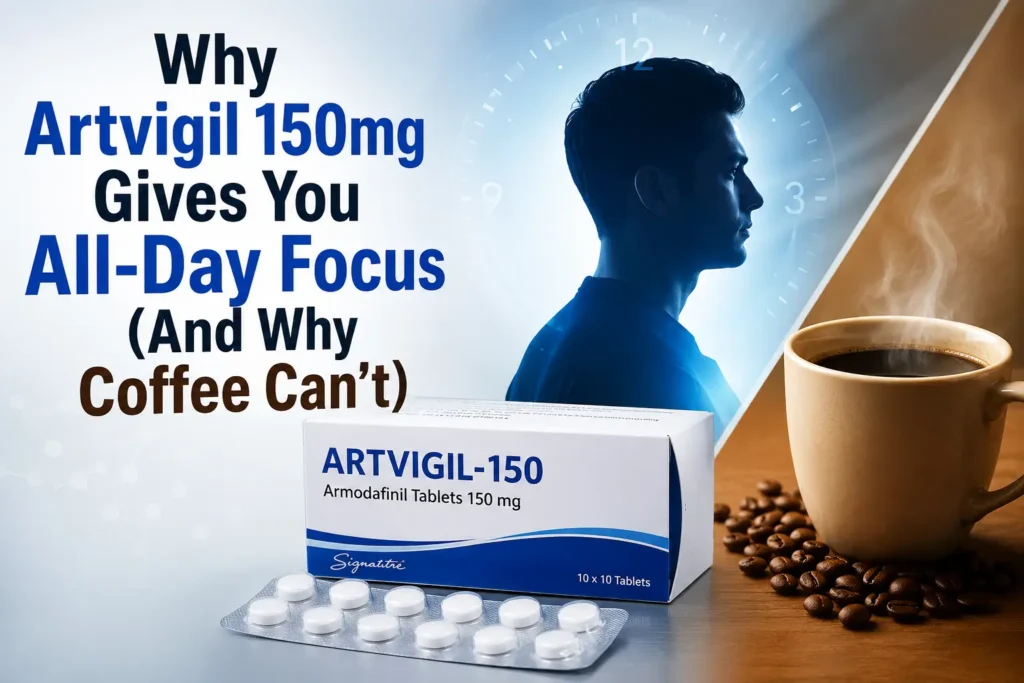
Staying focused throughout a demanding workday can be difficult, especially when poor sleep, night shifts, or excessive daytime sleepiness are involved. Coffee is one of the most common ways people try to stay alert, but caffeine generally provides a shorter-lived stimulant effect and may be followed by restlessness, a noticeable drop in energy, or difficulty sleeping later.
Artvigil 150mg is a brand of armodafinil, a prescription wakefulness-promoting medicine. Armodafinil is used medically to improve wakefulness in adults with excessive sleepiness associated with conditions such as narcolepsy, obstructive sleep apnea, and shift work disorder. The 150mg dose is an established dose for these indications.
The important distinction is that Artvigil 150mg should not be viewed simply as a stronger version of coffee or as a general-purpose productivity pill. Its approved medical role is to address excessive sleepiness, and its use should be guided by a qualified healthcare professional.
Artvigil 150mg contains armodafinil, the R-enantiomer of modafinil. Armodafinil promotes wakefulness through effects on several neurotransmitter systems involved in the sleep-wake cycle.
Unlike caffeine, which primarily works by blocking adenosine receptors, armodafinil has a different pharmacological profile. The precise mechanism responsible for its wakefulness-promoting effects is complex and is not completely understood.
The 150mg strength is particularly important because 150mg once daily is the recommended dose for adults with shift work disorder, while 150mg–250mg once daily is recommended for narcolepsy and obstructive sleep apnea in U.S. prescribing information.
The biggest difference between armodafinil and caffeine is their pharmacokinetic profiles.
According to prescribing information, armodafinil reaches peak plasma concentration at approximately two hours when taken while fasting, although food can delay the peak by around two to four hours. Its apparent terminal half-life is approximately 15 hours.
This does not mean that someone will experience the same level of alertness for 15 hours. A half-life describes how quickly the drug concentration declines in the body, not exactly how long a person feels its effects.
Nevertheless, the longer elimination profile helps explain why armodafinil can provide a more sustained wakefulness effect than a typical cup of coffee.
Real Also:- Artvigil 150 mg vs Artvigil 250 mg: Which Strength Should You Discuss With Your Doctor?
Caffeine is a relatively short-acting stimulant. It can make a person feel more awake relatively quickly, but its effects can vary considerably depending on caffeine tolerance, metabolism, sleep quality, and how much is consumed.
People may also drink several cups throughout the day to maintain alertness. This can increase total caffeine intake and may contribute to unwanted effects such as:
Therefore, comparing Artvigil 150mg directly with coffee is not really an apples-to-apples comparison. They are different substances with different medical roles and mechanisms.
| Feature | Artvigil 150mg | Coffee/Caffeine |
|---|---|---|
| Active ingredient | Armodafinil | Caffeine |
| Main medical role | Promotes wakefulness in specific sleep disorders | General stimulant beverage |
| Typical duration | Long pharmacokinetic profile | Generally shorter than armodafinil |
| Prescription medicine | Yes | No |
| Primary effect | Wakefulness promotion | Stimulation and reduced perception of fatigue |
| Recommended for everyone? | No | Not necessarily |
| Can affect sleep? | Yes | Yes |
The comparison should not be interpreted as saying that armodafinil is universally better than caffeine. For a healthy person who simply wants a morning beverage, coffee may be entirely appropriate. Armodafinil is a prescription medicine intended for specific medical situations.
Armodafinil has an apparent terminal half-life of about 15 hours. This is one of the main reasons its wakefulness-promoting effects can extend well beyond the initial part of the day.
Armodafinil is not primarily intended to create a temporary energy rush. Its approved use is to improve wakefulness in adults experiencing excessive sleepiness related to certain sleep disorders.
For approved indications, armodafinil is generally taken once daily. For shift work disorder, the recommended dose is 150mg approximately one hour before the start of the work shift.
This differs from the way some people use caffeine, where multiple servings may be consumed throughout the day.
Because of its long pharmacokinetic profile, armodafinil does not generally require repeated dosing during the day for its approved indications. However, patients should follow the dosing schedule prescribed by their healthcare professional rather than adjusting the amount themselves.
It is important to distinguish wakefulness from concentration.
If excessive sleepiness is interfering with someone’s ability to remain awake and attentive, improving wakefulness can indirectly make it easier to concentrate on tasks.
Clinical information for armodafinil supports its use for improving wakefulness in people with narcolepsy, obstructive sleep apnea, and shift work disorder.
However, Artvigil 150mg is not approved simply as a productivity enhancer for healthy people. Using it solely to work longer hours or study for extended periods should be discussed with a medical professional.
Shift workers can face a unique challenge because their work schedule may conflict with the body’s normal circadian rhythm.
Someone working overnight may become increasingly sleepy during the early morning hours. Coffee can temporarily increase alertness, but repeatedly using caffeine may also interfere with subsequent sleep.
Armodafinil 150mg has an approved role in managing excessive sleepiness associated with shift work disorder. The prescribing information recommends taking 150mg approximately one hour before the work shift.
This does not mean that every night-shift worker should use armodafinil. A healthcare professional should determine whether shift work disorder or another condition is present and whether treatment is appropriate.
Artvigil 150mg is not an ordinary supplement. Armodafinil is a prescription medicine and should be taken only according to professional medical advice.
The prescribing information includes important warnings concerning serious skin reactions, allergic reactions, psychiatric symptoms, cardiovascular considerations, and persistent sleepiness.
Common adverse reactions reported with armodafinil include:
If a person develops a rash, swelling, breathing difficulty, severe psychiatric symptoms, or another concerning reaction after taking armodafinil, they should seek prompt medical attention.
This is a question that should be discussed with a healthcare professional.
Combining a prescription wakefulness-promoting medicine with caffeine can potentially increase stimulant-related effects in some people. Depending on individual sensitivity and total caffeine intake, this may contribute to nervousness, palpitations, headaches, or difficulty sleeping.
If you have been prescribed armodafinil, tell your doctor or pharmacist about your usual caffeine consumption and any other medicines or supplements you take.
One important point is often overlooked: being awake does not necessarily mean being well-rested.
Armodafinil can promote wakefulness, but it should not be used as a substitute for adequate sleep.
For people with obstructive sleep apnea, the official prescribing information specifically explains that armodafinil treats excessive sleepiness rather than the underlying airway obstruction. Appropriate treatment of the underlying condition remains important.
Likewise, people who regularly work long hours should not use wakefulness-promoting medication to ignore persistent sleep deprivation.
Armodafinil 150mg may be prescribed for adults with excessive sleepiness associated with:
The approved indications and dosing should always be checked against the prescribing information applicable to the patient’s country.
A doctor may also consider factors such as other medicines, cardiovascular health, liver function, psychiatric history, age, pregnancy status, and previous reactions to modafinil or armodafinil.
Even when prescribed appropriately, armodafinil works best as part of an overall approach to managing excessive sleepiness.
Healthy habits can include:
Medication should not be used to compensate indefinitely for inadequate sleep.
Artvigil 150mg is a brand of armodafinil containing 150mg of the active ingredient. Armodafinil is a prescription wakefulness-promoting medicine used for excessive sleepiness associated with conditions including narcolepsy, obstructive sleep apnea, and shift work disorder.
Armodafinil has a long pharmacokinetic profile, with an apparent terminal half-life of approximately 15 hours. This supports prolonged wakefulness, although the exact duration and perceived effects vary between individuals.
It is not appropriate to describe the two as simply stronger or weaker. Caffeine and armodafinil work differently and have different purposes. Artvigil is a prescription medicine used for specific sleep-related conditions, while coffee is a common source of caffeine.
No. Artvigil 150mg should not be considered a replacement for adequate sleep. It promotes wakefulness but does not eliminate the biological need for sleep.
Armodafinil has an apparent terminal half-life of approximately 15 hours. This means the amount of medicine in the body decreases gradually rather than disappearing quickly.
For shift work disorder, prescribing information recommends 150mg approximately one hour before the start of the work shift. For narcolepsy or obstructive sleep apnea, the recommended adult dose range is 150mg to 250mg once daily in the morning. Individual dosing should always be determined by a healthcare professional.
Yes. Insomnia is among the commonly reported adverse reactions associated with armodafinil.
Do not assume that combining them is appropriate. Both can affect alertness and may contribute to unwanted stimulant-related effects. Discuss your caffeine intake with your doctor or pharmacist before combining them.
No. Armodafinil is not appropriate for everyone. Medical history, other medicines, allergies, cardiovascular considerations, psychiatric history, pregnancy, and other factors may affect whether it is suitable.
It is not approved simply as a productivity enhancer. Its established medical uses involve excessive sleepiness associated with specific sleep disorders. Using prescription medicines for cognitive enhancement without medical supervision is not recommended.
Artvigil 150mg and coffee are fundamentally different approaches to wakefulness. Coffee provides caffeine, which can offer a relatively quick stimulant effect but may wear off sooner and can cause unwanted effects when consumed in excess.
Artvigil 150mg contains armodafinil, a prescription wakefulness-promoting medicine with a substantially longer pharmacokinetic profile. Armodafinil’s approximately 15-hour apparent terminal half-life helps explain why its effects can support prolonged wakefulness compared with a typical caffeine serving.
However, the goal should not be to stay awake at any cost. Artvigil 150mg is intended for specific medical conditions, not as a routine replacement for sleep or a shortcut to productivity. Anyone considering armodafinil should consult a qualified healthcare professional, use it only as prescribed, and discuss possible interactions, side effects, and individual risks.
Medical disclaimer: This article is for general educational purposes and does not replace professional medical advice. Artvigil/armodafinil is a prescription medicine. Do not start, stop, combine, or change the dose of prescription medication without consulting a qualified healthcare professional.
Share :